The hiring mistake that costs you your best candidates

You’re probably passing on your strongest applicants without realizing it.
I’ve reviewed hundreds of tech resumes. The ones that get filtered out first are career switchers. Former teachers, salespeople, support specialists. Hiring managers see “non-traditional background” and move them to the B pile.
This is backwards. Career switchers bring pivot skills that traditional candidates take years to develop.
What pivot skills actually are
A pivot skill is a competency from a previous career that transfers to your current one.
Project management. Public speaking. Customer relations. Contract negotiations. Content writing. Video editing. These get treated as irrelevant when the job title says “Python Developer.” But they’re not irrelevant. They’re force multipliers.
The author who became a developer brings documentation skills that make your codebase more maintainable. The linguistics educator who pivoted to frontend development understands how users parse information and where interfaces confuse people. The salesperson turned full-stack developer knows how to scope requirements and manage expectations with stakeholders.
These skills don’t appear on a CS curriculum. They come from years of professional experience in other fields. And they compound with technical ability in ways that are hard to quantify but impossible to ignore once you’ve seen them in action.
Meet Sophie
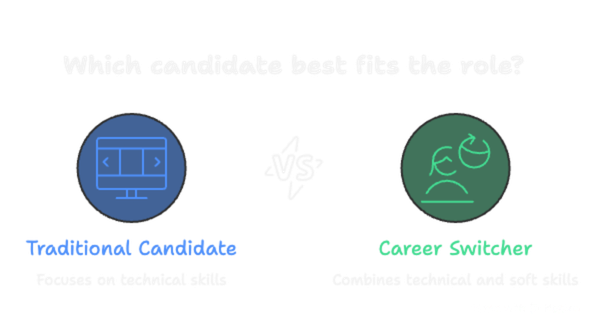
Sophie is 32. They just finished a coding bootcamp after 8 years in technical support. Their resume lands on your desk alongside 10 recent CS graduates.
You might rank Sophie lower. Less technical training. No internships at recognizable companies. No GitHub profile full of side projects started in high school.
But think about what 8 years in technical support actually means. Sophie can hear a user describe a problem, translate it into a workable bug report, break it into component parts, diagnose the root cause, and communicate the solution clearly.
That skill set takes years to develop in a new developer. Sophie has it on day one.
Sophie has also learned patience with frustrated users. They’ve figured out how to explain technical concepts to non-technical people. They understand that the first description of a problem is rarely the actual problem. These are not soft skills. These are professional competencies that directly affect code quality and team productivity.
What Sophie still needs
Sophie will need mentorship in code quality, test writing, and design patterns.
So will the CS graduate.
The difference is that Sophie already understands how to work with stakeholders, scope problems, and communicate across technical and non-technical audiences. The CS grad has theoretical knowledge of algorithms but limited professional experience with any of that.
Both candidates are starting points. Both need investment. But Sophie arrives with a decade of professional experience that shapes how they approach problems, collaborate with teammates, and handle ambiguity. The CS grad is starting from scratch on all of that.
Is one candidate inherently better than the other? No. Both offer real potential to a team. But only one type consistently gets the interview where they can prove themselves.
The specs you receive are terrible
Here’s something every working developer knows: the specifications you get from the business side are often vague, incomplete, or contradictory.
Your first job before writing any code is figuring out what’s actually being asked. What’s the real problem? What constraints weren’t mentioned? What assumptions need to be validated?
Career switchers do this instinctively. They’ve spent years translating between domains, clarifying ambiguity, and extracting requirements from people who don’t speak their language.
I remember countless times when my colleagues and I received poorly written specs from the business side. Before committing any code to an editor, our first job was figuring out exactly what was being asked of us. What precisely was the problem we were meant to solve?
Your company’s specs problem? A career switcher was solving that in their last job.
I know because I was one
I switched to tech after a decade in adult education, community organizing, and non-profit management.
My first manager didn’t hire me for altruistic reasons. There was a cost-saving factor. But regardless of motivation, that first break launched my career. Without that offer, who knows how much longer it would have taken to get my foot in the door?
My education and communication background shaped how I approached every technical problem, every code review, every stakeholder meeting. The strategic planning skills I developed running programs transferred directly to architecting systems. The communication skills I built explaining complex policies to community members helped me write better documentation and give clearer code reviews.
The data backs this up
According to the U.S. Bureau of Labor and Statistics, tech workers earn 3x more than the national average. That earning potential drives career switches. People make the leap because it can transform their financial security, their ability to save for retirement, their family’s stability. The ability to earn more can mean building generational wealth. It’s common to understate how much this matters, but we shouldn’t. The financial upside of tech careers is life-changing for many people.
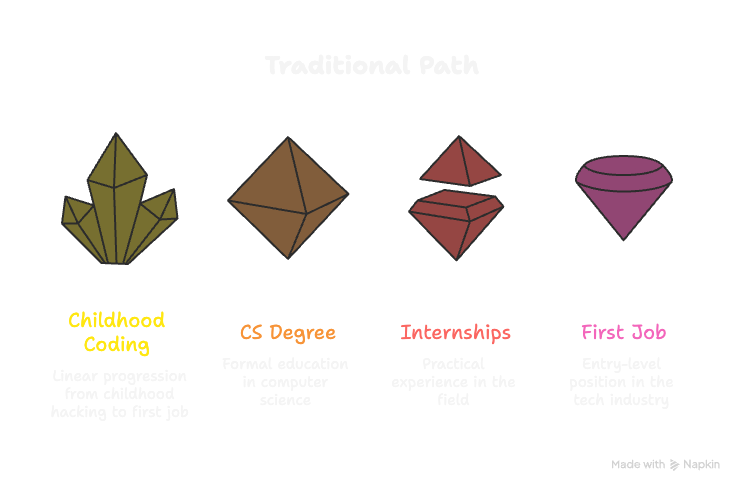
But the industry is full of people who followed the traditional path. Hacking as kids, CS in college, big-name internships. Career switchers look like anomalies. They get treated like liabilities.
They’re not liabilities. They’re assets with compound skills. It’s time to pay attention to them.
What you can do
If you’re involved in hiring decisions, you have real power here.
Stop treating career switchers as backup candidates. Look at their previous experience and ask what skills transfer. Technical support? That’s problem diagnosis and user communication. Teaching? That’s breaking down complex topics and reading an audience. Sales? That’s understanding stakeholder needs and closing gaps.
When you interview career switchers, ask about their previous work. How did they handle ambiguous situations? How did they communicate with difficult stakeholders? What systems did they build or improve? The answers will tell you more about their potential contribution than a whiteboard algorithm exercise.
The next Sophie who lands on your desk might be exactly who your team needs. Give them the interview where they can prove it.
What pivot skills have you seen make a difference on your team?